Middle East
The Hormuz safe route is an Iran to Oman arrangement, and tankers are still being hit
Esmail Baghaei said on 15 August 2026 that Iran and Oman had agreed a safe route through the Strait of Hormuz, following a 5 August accord on coordinates. On 14 August an ADNOC vessel was attacked there, the third in a week, and US Central Command said it had redirected 55 Iran linked ships.
.jpg)
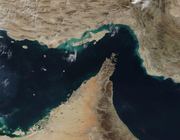
Iran's foreign ministry spokesman Esmail Baghaei said on Saturday 15 August 2026 that Iran and Oman had agreed a safe route for ships passing through the Strait of Hormuz, after roughly three weeks of talks. In the same remarks he set out the limit of that agreement. Full security in the strait, he said, could not be restored while United States maritime sanctions, military movements and a naval blockade remain in place. The arrangement being reported as a reopening is therefore a bilateral understanding between Tehran and Muscat, and by the spokesman's own account it does not resolve the thing making the waterway dangerous.
The groundwork was announced ten days earlier. On 5 August, Baghaei said Iran and Oman had reached an understanding on geographic coordinates for a shipping corridor through the strait, covering technical, legal, security and environmental provisions. Euronews reported that Tehran insists on charging passage fees on the basis of a claim to sovereign control of the waterway, a position directly at odds with the United States and Gulf states, which demand free navigation under United Nations maritime law. On whether Washington is involved, the two sides contradict each other outright: Tehran calls the United States a third party and says the negotiations have nothing to do with it, while President Trump insisted the United States is part of the Hormuz talks and that they were moving along very nicely. Trump also said the strait was going to be open very soon, or they were going to get hit very hard.
The shipping incident log for the same fortnight does not read like a reopening. On 14 August the United Arab Emirates accused Iran of attacking a vessel belonging to the Abu Dhabi National Oil Company as it transited the strait. State news agency WAM carried the accusation, and ADNOC said no injuries were reported and the situation was under control. Al-Monitor reported it was the third attack on ADNOC vessels in a week, all attributed by the UAE to Iran, and noted separately that the United Kingdom Maritime Trade Operations agency had reported a bulk carrier struck by an unknown projectile on the Friday, without establishing whether it was the same ship. The UAE foreign ministry demanded that Tehran stop what it called unprovoked actions and fully reopen the waterway. Anwar Gargash, diplomatic adviser to the president, said the country would safeguard our rights to freedom of navigation while continuing the path of dialogue. Iran did not immediately comment.
A week before that, ADNOC put a number on the cumulative damage. Reuters reported on 7 August, in an account recorded in Wikipedia's current events log for that date, that the company said 15 of its vessels had been attacked by missiles or drones while transiting the strait since the war with Iran began on 28 February 2026. Reuters' own page could not be retrieved for this article, so the figure is reported here as it appears in that log rather than from the original.
The American blockade is not notional. Middle East Eye reported on 10 August that United States Central Command said that as of 9 August it had redirected 55 commercial vessels as part of what it described as strict enforcement of the United States blockade against Iran, and had also disabled two vessels and inspected two others, with more than 20 American warships supporting the operation. The announcement was made through CENTCOM's official account on 9 August.
The closure itself dates to March. The South China Morning Post reported that on Friday 27 March 2026 Iran's Revolutionary Guards announced through their Sepah News website that the movement of any vessel to and from ports of origin belonging to allies and supporters of what they called the Zionist American enemies was prohibited, and said they had turned back three container ships of different nationalities that morning. The Guards described President Trump's claim that the strait remained open as a lie.
Some traffic has kept moving throughout. India's shipping minister Sarbananda Sonowal told parliament on 7 August that 62 India bound vessels had transited the strait safely as of 3 August, 23 of them Indian flagged and 39 foreign flagged, and that about 4,052 seafarers had been repatriated from the Gulf. The Directorate General of Shipping has made full International Ship and Port Facility Security Code measures mandatory and has discouraged Indian seafarers from voyaging through the Gulf, running a 24 hour control room and issuing situation reports every 24 hours. That is what a functioning corridor looks like in practice: convoys, advisories and a casualty compensation scheme, rather than open water.
What is not established is substantial. Neither Iran nor Oman has published the text of the understanding or the coordinates it fixes. No fee schedule has been released, and it is unclear whether any fee has been paid or collected. No Omani statement confirming Baghaei's account was available in the sources opened for this article, so the arrangement rests for now on one party's description of it. It is also unknown whether the route is open to all flags or only to some, and whether vessels using it are being attacked anyway.
Sources
Every factual claim above rests on the 10 published sources below. They are listed so you can check the reporting rather than take it on trust.
- Iran InternationalIran says safe route agreed with Oman for Strait of Hormuz shipping
- EuronewsIran and Oman agree route for ships in Strait of Hormuz, Tehran says
- Al-MonitorUAE says Iran attacked ADNOC vessel in Hormuz, urges waterway reopening
- Middle East EyeUS says it has rerouted 55 Iran-linked vessels
- South China Morning PostIran says Hormuz closed to shipping to and from enemy ports
- Lokmat Times62 India-bound ships sailed safely out of Hormuz amid West Asia crisis, minister says
- WikipediaPortal: Current events, 7 August 2026
- WikipediaPortal: Current events, 15 August 2026
- WikipediaPortal: Current events, 5 August 2026
- Wikipedia2026 Iran war
More in World News

A Stockholm court put Google's Shopping bill at 14.3 billion kronor and found the abuse ran past 2017

Sixty six jurisdictions cleared the Paramount takeover of Warner Bros. Discovery. A US court has it frozen

The General Assembly backed the World Court's climate opinion 141 to 8, but the reparation test is narrow