Astronomy
Nature names MoM-BH*-1, but the black hole star idea dates to March 2025 and is still contested
A team led by Rohan Naidu published MoM-BH*-1 in Nature on 12 August 2026, a black hole wrapped in a gas envelope about 1,000 astronomical units across, 660 million years after the Big Bang. The same object was posted as a preprint on 20 March 2025, and rival papers this year dispute the model.
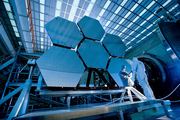

A paper published in Nature on 12 August 2026, DOI 10.1038/s41586-026-10846-4, sets out an object its authors call MoM-BH*-1: a growing black hole at redshift of about 13, seen 660 million years after the Big Bang, cloaked in a dense, dust free envelope of hydrogen and helium roughly 1,000 astronomical units across. For comparison, the Institute of Science and Technology Austria, whose Jorryt Matthee is on the team, puts the Sun's radius at about 0.01 astronomical units, making the envelope more than 100,000 times larger.
The evidence rests on the shape of the spectrum. ISTA reports a Balmer break, a sharp step in brightness across a particular wavelength, of about a factor of 7.7, against about 2.6 for the bright star Vega. Rohan Naidu told MIT that the break is the deepest ever observed in any object, which he says rules out ordinary stars. MIT's own account quotes him saying the team thinks there is a central black hole about 100,000 times the mass of the Sun, and that the result looks a bit like a star but is 100 billion times brighter. The object was picked up by the James Webb Space Telescope under a survey named Mirage or Miracle, using programmes GO-3516, GO-5224 and GO-1837, with supporting observations from the European Southern Observatory's Very Large Telescope.
The widely repeated framing is that a brand new class of object has been discovered. That is not quite what the record shows. Naidu and 50 colleagues posted a preprint on 20 March 2025, arXiv:2503.16596, titled A Black Hole Star Reveals the Remarkable Gas Enshrouded Hearts of the Little Red Dots. It describes a source 660 million years after the Big Bang with among the largest hydrogen Balmer breaks reported at any redshift, broad multi peaked H beta emission and Balmer line absorption, and models it as a black hole star. The Nature paper is the peer reviewed publication of a claim that has been in circulation for about 17 months.
In between, the idea has been extended. Anna de Graaff, Naidu and 35 co authors submitted a study of 116 little red dots at redshifts 2.3 to 9.3 on 26 November 2025, finding their continuum spectra are well described by modified blackbodies at around 5,000 kelvin. Andrea Weibel, Naidu and colleagues posted a photometric selection of 241 black hole star candidates spanning redshifts about 1.7 to 9.3 on 15 June 2026, with inferred black hole masses of roughly 10,000 to 10 million solar masses under an assumption of Eddington limited accretion.
Other groups disagree. Rosa Mérida and four co authors, in a paper submitted on 10 June 2026, analysed 66 little red dots at redshifts 2 to 6 and found only about 6 per cent were best fitted by a black hole star in the optical with a host galaxy in the ultraviolet. That figure rose to about 40 per cent once priors favouring the model were imposed, which the authors present as evidence of a strong degeneracy between the black hole star solution and alternatives rather than as support for it. Jean Baptiste Billand and colleagues, in a paper submitted on 13 April 2026, measured compactness, spectral shape and broad H alpha strength across about 48,000 galaxies and concluded that little red dots are the extreme tail of a continuous distribution rather than a distinct class.
There is also a competing physical model. Devesh Nandal and Abraham Loeb argue that little red dots are primordial supermassive stars of up to a million solar masses, reproducing the V shaped Balmer break as an intrinsic photospheric effect, and report matching the H beta line width of MoM-BH*-1 to within 4 per cent. The Center for Astrophysics, Harvard and Smithsonian publicised that work on 5 August 2026, a week before the Nature paper appeared.
Two details in the coverage do not line up. MIT describes Naidu as a NASA Hubble Fellow and Pappalardo Fellow at its Kavli Institute for Astrophysics and Space Research, while the ISTA release gives his affiliation as the University of Hawai'i. Phys.org carried an MIT sourced write up dated 16 August 2026, four days after MIT and ISTA dated the publication to 12 August.
What remains unknown is the mass. ISTA states plainly that the exact black hole mass is undetermined, and Weibel's masses depend on an accretion assumption. Whether every little red dot contains such an object is also open, and the Mérida and Billand papers are direct arguments that many do not.
Sources
Every factual claim above rests on the 10 published sources below. They are listed so you can check the reporting rather than take it on trust.
- MIT NewsAstronomers discover a brand-new type of astrophysical object: a black hole star
- Institute of Science and Technology AustriaBlack Hole Star: Mirage or Miracle?
- Phys.orgMirage or miracle? JWST finds earliest known 'black hole star' at cosmic dawn
- Phys.orgBlack hole star: Astronomers discover a brand-new type of astrophysical object
- arXivA 'Black Hole Star' Reveals the Remarkable Gas-Enshrouded Hearts of the Little Red Dots
- arXivLittle Red Dots host Black Hole Stars: a unified family of gas-reddened AGN revealed by JWST/NIRSpec spectroscopy
- arXivBetween Degeneracy and Evolution: UV-to-optical Insights into the BH* Model in Little Red Dots
- arXivDo little red dots really form a distinct class of astronomical objects?
- arXivSupermassive Stars Match the Spectral Signatures of JWST's Little Red Dots
- Phys.org'Little red dots' may be pulsating monster stars that created early-universe black holes
More in Science
AI-designed viruses clear peer review, then an independent check finds them close relatives of the natural original
Arizona physicists shift the quantum noise inside a light pulse, and watch it move in real time
Artemis II flew four people 252,756 miles from Earth in April, but the first landing is now Artemis IV in 2028