Science
AI-designed viruses clear peer review, then an independent check finds them close relatives of the natural original
Science published the Stanford and Arc Institute bacteriophage work on 6 August 2026. Six days later an Oxford researcher reported that the 16 working viruses were on average about 97 per cent identical to the natural phage they were modelled on.
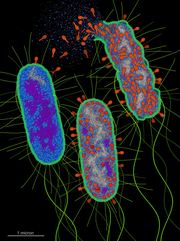
Science published the paper, "Generative design of bacteriophages with genome language models", on 6 August 2026. The work comes from Stanford University and the Arc Institute in Palo Alto, led by Brian Hie, an assistant professor of chemical engineering at Stanford and an innovation investigator at Arc, with Samuel King, a Stanford bioengineering graduate student. Stanford's report on the paper calls it the first peer-reviewed demonstration of generative AI designing entire functional viral genomes. The Arc Institute had announced the underlying manuscript as a bioRxiv preprint on 17 September 2025.
Two genome language models, Evo 1 and Evo 2, produced hundreds of thousands of candidate genomes. Stanford says nearly 300 went to chemical synthesis and 16 assembled into working bacteriophages, viruses that infect bacteria, which killed E. coli in the dish. The Arc Institute, describing the preprint, put the number of designs tested experimentally at 285.
The template was ΦX174, which the Arc Institute describes as a 5,386-nucleotide bacteriophage carrying 11 genes. Arc says the models were trained without sequences from viruses that infect humans, animals or plants, an exclusion intended to make it impossible for Evo to generate human viral sequences.
Stanford reports that the 16 phages, combined into a single cocktail, wiped out two E. coli strains that had already become resistant to a naturally occurring phage. That is the practical case for the work: phage therapy against bacteria that antibiotics no longer reach.
The harder finding arrived six days after publication. On 12 August 2026 IEEE Spectrum, in a report by Elie Dolgin, described an independent analysis by Oliver Crook, a computational biochemist at the University of Oxford. Crook found the 16 viable genomes were on average about 97 per cent identical to the ΦX174 template, and that placed on a family tree they fell inside the existing spread of phage diversity rather than branching away from it. "What we saw, at a very plain view, were brothers and sisters of the original virus," Crook told the magazine. Spectrum also reported that the model had been fine-tuned on roughly 15,000 genomes from ΦX174's own relatives.
Hie and King did not dispute the sequence figures. They told Spectrum the novelty was functional rather than genetic: several designs differed in protein structure, growth kinetics and infection behaviour, and one carried an unusually truncated protein borrowed from a distant phage species that still worked inside the ΦX174 backbone. Chase Beisel, identified by Spectrum with the Botnar Institute and Locus Biosciences, told the magazine the value lay not in making viruses unlike nature but in searching combinations of genetic changes evolution has never produced.
Specialists gathered by the Science Media Centre on 6 August 2026 divided on significance and agreed on caution. Simon Jackson, who leads the phage therapy research group at Waikato University, noted that only around 5 per cent of the designs worked and that about half acquired mutations, which he read as natural evolution doing part of the job. Jordi García Ojalvo, professor of systems biology at Pompeu Fabra University, said the risk is lower than with text-based large language models because every design still has to be built and tested in a laboratory. Simon Clarke, associate professor in cellular microbiology at the University of Reading, said the work raises serious regulatory and safety concerns.
Science published a Perspective alongside the paper by Thomas Inglesby and Moritz Hanke of the Johns Hopkins Center for Health Security. "The ability to compose viral genomes using generative AI now exists; the governance to safely steer it does not," they wrote, arguing that new disease-causing viruses should not be pursued at all.
A biosecurity study published in Science on 2 October 2025 by Bruce Wittmann, Eric Horvitz and colleagues bears directly on that oversight question. It found that open-source protein design tools could generate variants of known proteins of concern that the screening software used by DNA synthesis providers failed to catch. The same team then built and deployed patches that cut the miss rate to a few per cent.
The law has not moved. Executive Order 14292, signed on 5 May 2025, required the 2024 United States framework for nucleic acid synthesis screening to be revised. Writing in Frontiers in Bioengineering and Biotechnology in May 2026, Meghan Seltzer and colleagues recorded that updated White House guidance had still not been issued. In June 2026 an open letter published at screendna.org asked Congress to legislate mandatory screening, customer verification and recordkeeping this session. Its signatories include Sam Altman of OpenAI, Dario Amodei of Anthropic, Demis Hassabis of Google DeepMind, Emily Leproust of Twist Bioscience, David Baker of the University of Washington and Inglesby himself.
Congress has not acted, and screening synthetic DNA orders in the United States remains voluntary. The question the Oxford analysis leaves open, whether a genome 97 per cent identical to its template has been designed or rearranged, is unsettled, and it will shape how the next claim of a first in this field should be read.
Sources
Every factual claim above rests on the 11 published sources below. They are listed so you can check the reporting rather than take it on trust.
- ScienceGenerative design of bacteriophages with genome language models
- ScienceAI-designed viral genomes (Perspective, Inglesby and Hanke)
- Arc InstituteHow We Built the First AI-Generated Genomes
- IEEE SpectrumAI Designed Functional Viruses. But How New Were They?
- Science Media CentreExpert reaction to generative design of bacteriophages with genome language models
- Stanford ReportAI designs a novel E. coli killer
- Science / Microsoft ResearchStrengthening nucleic acid biosecurity screening against generative protein design tools
- screendna.orgAn Open Letter in Support of Mandatory Nucleic Acid Synthesis Screening and Recordkeeping
- Frontiers in Bioengineering and BiotechnologySecuring the U.S. nucleic acid synthesis industry: a case for safe-harbor information sharing
- Frontiers in Bioengineering and BiotechnologyStrengthening global biosecurity for synthetic nucleic acid technology: from sequence screening to risk-based governance in the AI era
- BetaNewsStanford, Arc Institute scientists design first AI-generated viruses
More in Science

Arizona physicists shift the quantum noise inside a light pulse, and watch it move in real time

Artemis II flew four people 252,756 miles from Earth in April, but the first landing is now Artemis IV in 2028

Nature names MoM-BH*-1, but the black hole star idea dates to March 2025 and is still contested